
Previous Residents at Beavercreek Township Addresses
One Beavercreek Township address can have several legitimate histories: the land title, the household, the structure, and the surrounding road geography. The first task is to pin down the parcel and legal description through the county. The next task is to move backward through deeds and only then match a dated directory, census, obituary, or probate record. That sequence also answers the narrower question, who lived here before, without mistaking a property owner for every member of a household. Greene County’s sources are unusually useful because an online recorded-document trail is paired with a counter, archives, and library route for older work.
| Historical source | Verified coverage | Where the Beavercreek Township search goes | What it can show |
|---|---|---|---|
| Recorder document index | 1984 to present online | CountyFusion public search | Recorded parties, instrument details, and a recent title trail. |
| Recorder deed custody | 1803 to present | Greene County Recorder counter or request route | Older deeds when the web index ends. |
| Archives transcribed deeds | 1804 to 1864 | Greene County Archives | Early local transfers and title clues. |
| Directories and newspapers | Directories to 1870; newspaper film to 1814 | Greene County Room | Occupants, notices, obituaries, and local context. |
| Birth and death indexes | Births 1869 to 1909; deaths 1870 to 1909 | Archives Online Resources and reading room | Dated household and life-event corroboration. |
| Federal census | Decennial releases; 1950 is latest released in the research period | National Archives and library genealogy access | A household snapshot, not annual address proof. |
For a recent property, start online with the parcel and Recorder index. For a nineteenth-century question, lead with the Recorder counter, Archives catalog, and Greene County Room. The historic sources do not promise a complete list of past residents, but together they can separate the property owner from an occupant and put both in an accurate time frame.
Beavercreek Township Historical Records Boundary
The Recorder’s online index starts in 1984. That is an online-search boundary, not the start of Greene County land history. The Recorder reports deed custody from 1803 to the present, and the Archives holds transcribed deeds from 1804 through 1864. The Greene County Room also has some microfiche deeds and microfilm deed indexes. Those overlapping channels make a much better previous-residents trail than a web no-result.
Use the county-linked Recorder portal by choosing Login as Guest, accepting the terms, and selecting Search Public Records. County instructions verify name, Plat Book/Page, Plat Cabinet/Page, and Survey Book/Page routes for relevant materials. Keep the book, page, cabinet, survey, instrument, and legal-description references that appear in a result. They are the bridge to a counter or archive request when a historic step is not online.
Note: The Recorder’s 2023 scanning project for books from 1803 to 1979 shows continuing digitization work, but it does not establish that every earlier image is online.
Beavercreek Township Recorder Record Copies
The Greene County Recorder FAQ explains what to do when a watermarked web image is not enough. The county says an unwatermarked self-service official copy is $0.10 per page. A staff-made copy is $2.00 per page, and phone orders add mailing or fax cost. The same FAQ points to the county request portal and preserves email, mail, fax, and in-person submission routes. Ask for a narrow document, date range, party name, legal description, or book/page reference.
The Recorder copy and request guidance appears in the screenshot below.
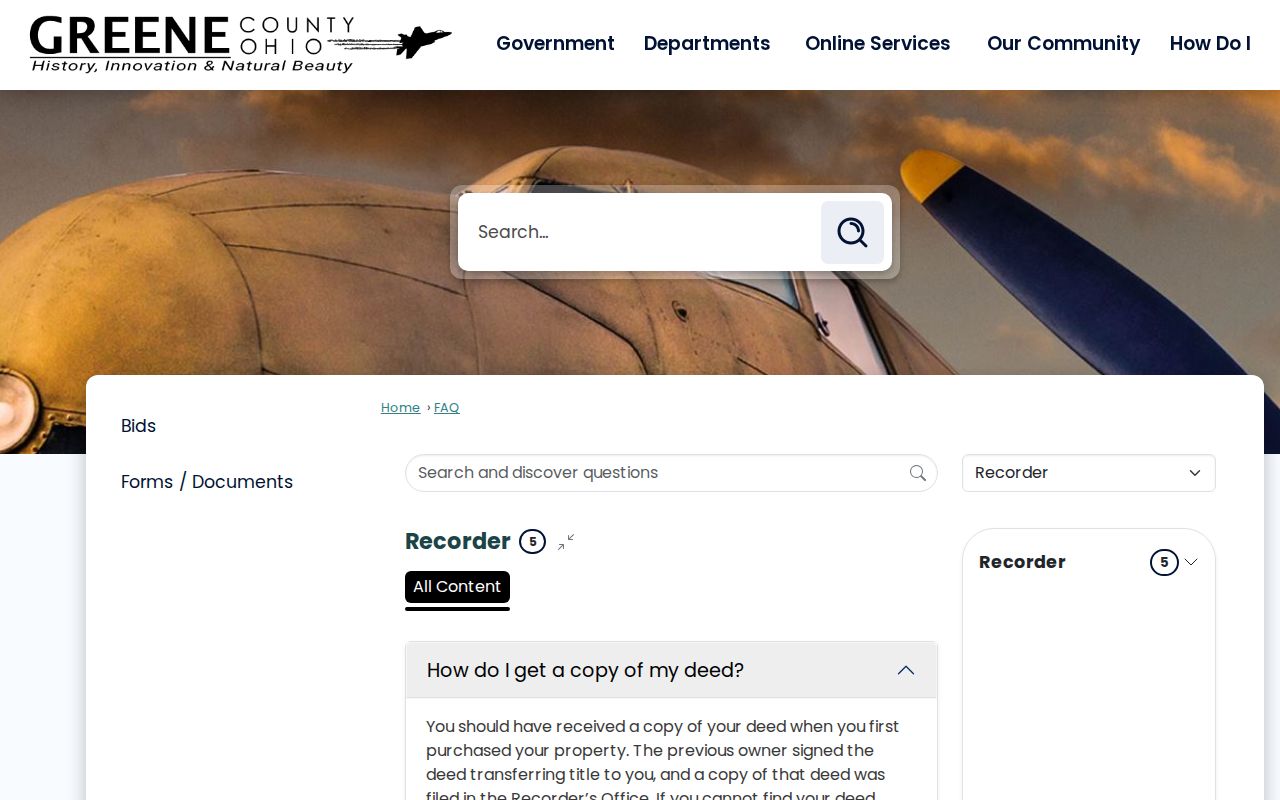
A watermarked internet image can help identify a record, while an office copy is the better route when an unwatermarked official copy is needed.
Beavercreek Township Deed Records for Past Residents
The deed chain starts at the present parcel rather than a surname. Use the Greene County Auditor Real Estate Search to find a likely parcel by owner name, parcel number, or address. The property record can supply the situs, owner, legal description, transfer context, and parcel identifier. Then use the recorded instrument to test the transfer. It is important not to turn the owner or mailing address into an unsupported claim that someone lived at the property.
- Record the current parcel identifier, legal description, situs address, and transfer clue from the Auditor record.
- Find the current purchase instrument in the Recorder index and note the grantor, grantee, recording date, document type, and book, page, or document number.
- Search the prior seller as a grantee, or use the legal description and plat reference to find the earlier conveyance.
- Repeat each dated transfer backward, keeping split parcels, probate transfers, name changes, and boundary changes as separate research questions.
- At 1984, move to the Recorder counter, Greene County Room microfilm, and Archives records rather than treating the online result as the end of the chain.
- Grantor and grantee
- The grantor transfers an interest in a record. The grantee receives that stated interest.
- Chain of title
- The documented sequence of recorded transfers for a property. It is a research trail here, not a title opinion.
- Legal description
- The lot, block, subdivision, survey, or metes-and-bounds wording that identifies land more reliably than an old street number.
Beavercreek Township Address Records Across Time
Old addresses can fail even when the house or parcel is the same. Greene County’s historic-property guide warns that street names and house numbers may have changed. No official source located a single township-wide renumbering year, so a previous-residents search should not invent one. Carry the legal description, subdivision or lot, historic road name, parcel history, and map comparison through each period.
Modern township addresses use a county grid centered at Main and Detroit Streets in Xenia. That system is useful for present identification, but it does not prove that a rural address used the same number decades earlier. County atlases from 1855, 1874, and 1896, historic maps, and the late-1970s onward Ohio Historic Inventory can help date a place. The inventory is arranged by township, road, and current house number, which can bridge an unincorporated-area search while still requiring a date check.
Beavercreek Township Previous Residents in Households
Deeds follow ownership. Household sources can identify who lived at a place during a particular period, but they must be read on their own terms. The Greene County Room’s city-directory collection reaches 1870 and its newspaper microfilm reaches 1814. A volume may be organized around Xenia, Fairborn, Beavercreek, Alpha, a rural route, or another nearby label instead of the township boundary. Check the title page, coverage statement, and any street or reverse section before treating an entry as local evidence.
- Select directory years that fall near the transfer dates established in the deed chain.
- Record the exact place name, year, address wording, and resident or occupant notation from the volume.
- Pair that finding with the nearest available federal census, remembering that a census is a snapshot on its enumeration date and a directory may be compiled at another time.
- Use a newspaper notice, obituary, cemetery record, or probate file to test a move, death, widow notation, or estate transfer.
The collections have their own access details on the Beavercreek Township city directory page. For a who lived here before question, they remain supporting evidence beside the parcel and deed, not a replacement for either.
Lawful use. Beavercreek Township previous-residents research is for house history, family history, estate work, and personal curiosity. Do not use historical records to track, harass, or contact a living person.
Beavercreek Township Vital Record Trail
Life-event evidence can explain why an owner disappeared from a deed chain or why a directory changes. Greene County Public Health maintains local births and deaths from 1909 forward, while the Archives supplies earlier county indexes for births from 1869 to 1909 and deaths from 1870 to 1909. Ohio History Connection’s death index adds statewide certificate ranges, but an index hit should be checked against the certificate, obituary, cemetery, probate, or property evidence before it is used to identify a past household.
The Ohio vital-record access statute shown below governs certified copies and signed applications.
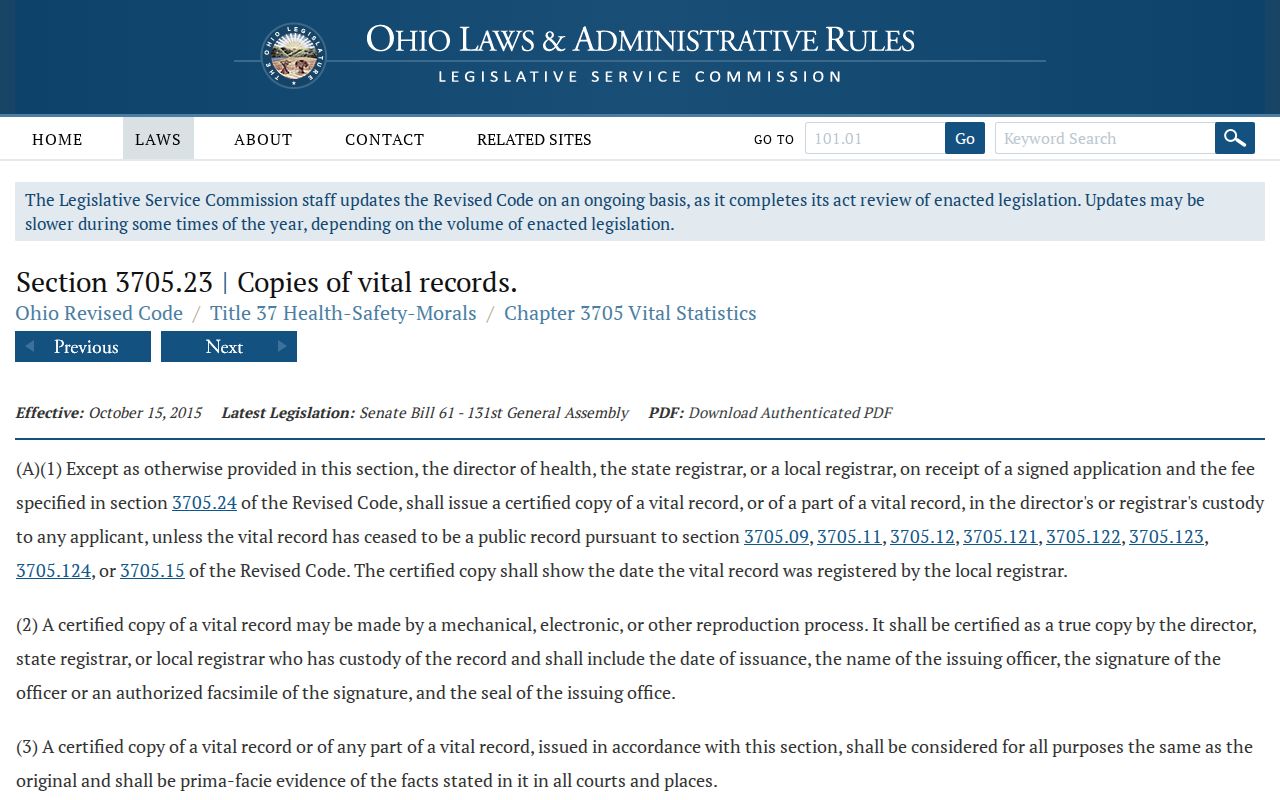
Under R.C. 3705.23, a signed application and fee apply to a certified copy, and recent death records have a special restriction on the decedent’s SSN.
For a Greene County event from 1909 forward, Public Health is the local issuing route. A mail or dropbox request needs a completed signed application, the allowed payment, and a business-size self-addressed stamped envelope. In-person, mail, dropbox, and the authorized online processor are separate access choices. A marriage lead follows a different path through Probate Court, where the county states that October 1991 to present is searchable. Older material should be checked with the live court or the Archives rather than assumed to follow one uniform custody rule.
Beavercreek Township Early Resident Records
Greene County’s deeper record trail gives this work a practical offline route. Recorder deeds extend to 1803, Archives transcriptions cover 1804 through 1864, probate inventory begins with listed administrations and guardianship series in 1814, and county birth and death ledgers begin in 1869 and 1870. The Numbers story here is not a claim that every name is online. It is a reason to take an address, legal description, and date to the archive when the modern database stops.
The Ohio administrative rule shown below explains the historical transfer periods for certain vital records.
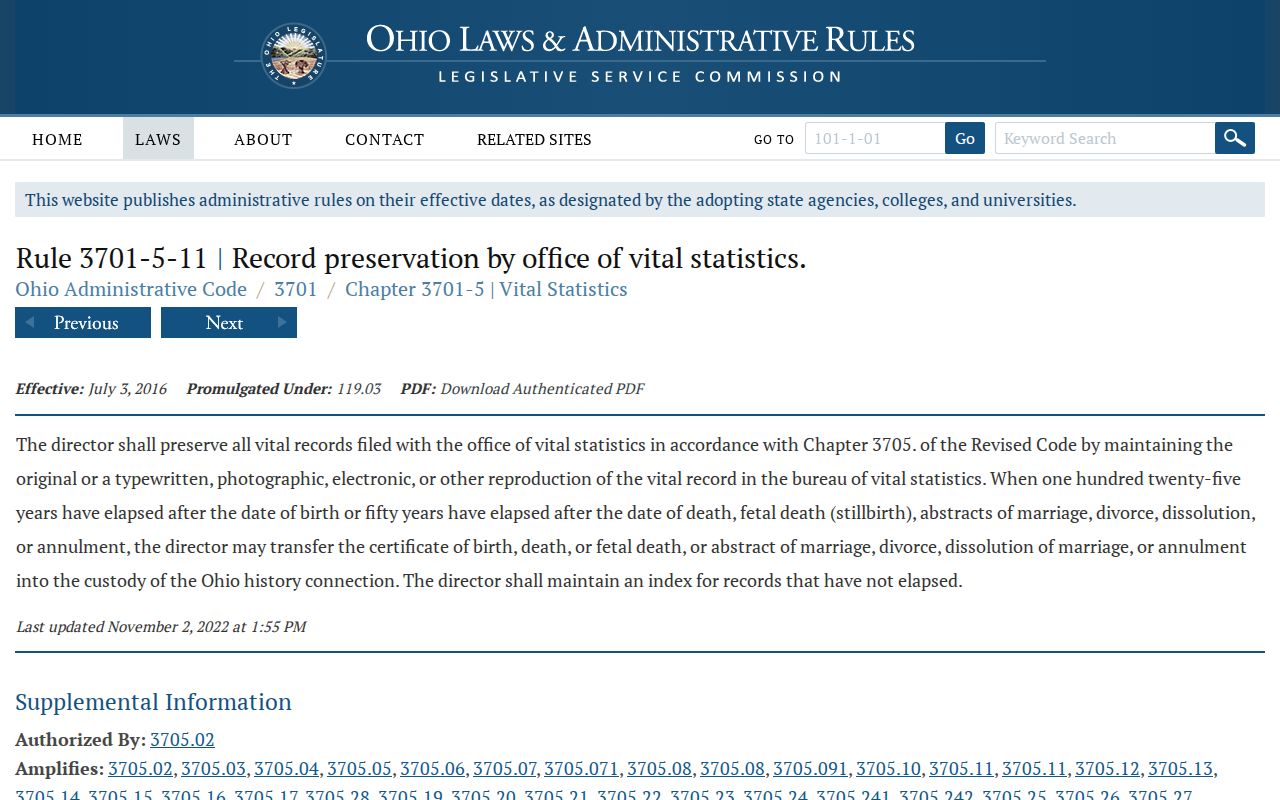
Birth records may transfer after 125 years and death, marriage, divorce, dissolution, and annulment abstracts after 50 years under OAC 3701-5-11. Transfer describes archive custody, not a shortcut around a record’s ordinary access rules.
Greene County Archives offers a catalog, digital repository, reading room, and remote reference-request route. Its catalog is not the digitized collection, so a search result may require a reading-room or staff follow-up. Its keyword features include exact phrases, exclusions, and wildcard searching, which can help with surname variations. The reading room at 535 Ledbetter Road in Xenia is open Monday through Friday from 9 a.m. to 4 p.m.; an appointment is encouraged but not required. Holdings are non-circulating, and remote researchers can submit an online reference request when a visit is not practical.